
2026 Income Tax Return: Foreign bank account balances must be reported
15/05/2026Deadline Reduction for NF-e Recipient Manifestation
29/05/2026EXPERT OPINION
IFRS 18: Understand what is changing and how it affects your company
Companies that prepare financial statements in accordance with IFRS will be affected and must adjust how they report results to the market
By Marluci Azevedo
The changes to IFRS 18 (CPC 51) mark the beginning of a new era in global corporate transparency. Companies that adopt international accounting principles will need to change the way they present their financial results starting in 2027.
More than just a technical update, this measure establishes a standardization framework, providing more transparent and comparable information on companies’ financial performance.
The goal is to eliminate data asymmetries, providing a solid and direct basis for comparison between different companies, without the distortions caused by the ambiguous metrics and classification used to date. The standard will unify the structure of the Statement of Comprehensive Income (SCI).
This change is expected to contribute to:
- greater comparability in the statement of profit or loss (income statement);
- improved transparency of performance measures defined by management;
- a more useful grouping of information in the financial statements.
IFRS 18 requirements
The obligation to present financial statements in accordance with the provisions of IFRS 18 becomes effective on January 1, 2027.
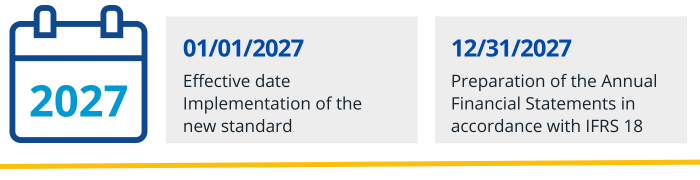
One point to note, however, is that it will be necessary to provide comparative data from 2026, which was prepared using a different methodology. As a result, companies should anticipate significant impacts on their processes and systems.
The need to restate historical data and address internal issues requires that planning be already underway or be initiated as soon as possible. Companies that neglect this transition may suffer from inconsistent data and, consequently, a loss of market confidence.
What’s changing under IFRS 18
The following topics represent the main changes:
|
Income Statement Structure
|
Classification by category: Operating, Investment, Financing, Income Taxes, and Discontinued Operations. Required subtotals: operating income, income before financing and income taxes. |
|
Aggregation and disaggregation
|
Group and aggregate items with similar characteristics; Disaggregate items with different characteristics; Material information must be disaggregated. |
|
Disclosure of Performance Measures
|
Disclosure in notes to the financial statements; isclosure of the basis for calculating the Management Performance Measures (MPMs) presented. |
IFRS 18 introduces three categories for revenue and expenses (operating, investing, and financing), and companies must adapt to this new framework to improve their income statements.
The standard requires defined subtotals, including operating income, in order to provide a consistent starting point for performance analysis and comparisons.
Another key point is the organization of information regarding what should be presented in the main financial statements or in the notes to the financial statements.
Impacts and necessary adjustments
At the operational level, it will be necessary to update the controls that underpin the financial statement closing and preparation cycle. Companies will also need to identify any gaps in their IT architecture to support the accounting close and the various reporting formats.
It will be essential to manage the transition from historical reports to the new definition of operating profit. There is also the challenge of adapting the chart of accounts to support the new recategorization requirements, ensuring that the current accounting structure is capable of providing the required level of detail.
This shift is not only technical but also human and multidisciplinary, requiring a clear identification of the organizational roles that will be affected and the engagement of teams so that the new compliance guidelines are effectively adopted by those involved.
Consulting Services for IFRS 18 Compliance
Given the complexity of this change and its technical aspects, it will be essential to have specialized support during the process of adapting to the provisions of IFRS 18, ensuring compliance with the new requirements for the presentation and disclosure of financial statements.
From diagnosis to implementation, including the adjustment of accounting, tax, operational, and systemic practices to meet the new requirements, you can count on the full support of the Domingues e Pinho Contadores team. Contact us: dpc@dpc.com.br.

Author: Marluci Azevedo, partner at Domingues e Pinho Contadores.
How can DPC help your company?
Domingues e Pinho Contadores has specialized team ready to assist your company.
Contact us by the e-mail dpc@dpc.com.br
See more
Sign up for our Newsletter:
Are you interested?
Please contact us, so we can understand your demand and offer the best solution for you and your company.

Rio de Janeiro
Av. Rio Branco 311, 4º e 10º andar - Centro
CEP 20040-903 | Tel: +55 (21) 3231-3700
São Paulo
Rua do Paraíso 45, 4º andar - Paraíso
CEP 04103-000 | Tel: +55 (11) 3330-3330
Macaé
Rua Teixeira de Gouveia 989, sala 302 - Centro
CEP 27910-110 | Tel: +55 (22) 2773-3318